Applies to Valheim 1.0, patch 1.0.20 (released October 15, 2026), on PC, Xbox, PS5 and Switch 2. Valheim left Early Access on September 9, 2026 with the Deep North biome and, per Iron Gate's official 1.0 announcement, "80+ new buildable pieces." Structural-integrity values below come from the Valheim Wiki's Building stability breakdown of the game code. Comfort, raid and tool values come from the community Valheim Wiki. Updated October 23, 2026.
Building is the reason a lot of people never put Valheim down. Iron Gate pitches it plainly on the official site: "Raise your own viking mead halls, houses, castles, and more with our powerful construction interface." Underneath that pitch are real rules. Physics knocks towers over, rain rots your walls, and a comfort system quietly sets how fast you heal.
This guide covers the mechanics that matter in 1.0: how structural integrity works, which materials are strongest, what the Deep North added, how to max comfort (the cap went up to 22, not the 17 older guides still quote), and how to keep raids from flattening your base.
Quick answer: Valheim building in 60 seconds
- You build with the Hammer (3 wood + 2 stone), inside the radius of a Workbench (10 wood). Place the Workbench first at every new base.
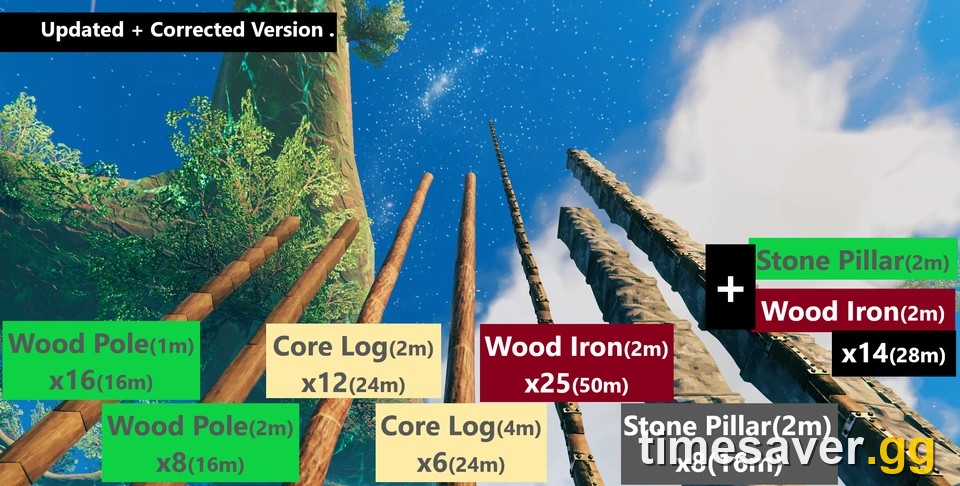
- Structural integrity is inherited support. A straight-up column of wood or stone tops out at 16 m, core-wood log poles at 24 m, wood-iron poles at 50 m.
- Stone is durable but can't overhang on its own. Its horizontal loss factor is 1.0, so a stone piece hanging off the side of a single support gets no support. Height and overhangs come from iron.
- Grausten (Ashlands) has the highest max support of the main building materials: 2,000, ahead of iron and black marble (1,500) and stone (1,000).
- Max comfort is 22 in 1.0, which gives 29 minutes of Rested (comfort + 7). Only the best item in each category counts.
- Deep North: you can't build on the ground until you clear the snow with the new Snow Shovel (level-3 Black Forge). Chop Deep North fir and pine logs for Timberwood, which unlocks the new Timber and Scalewood pieces.
- Most raids need 3 base structures within 40 m of you (the wolf hunt is the exception). Every 46 minutes there's a 20% chance of an event.
How does building work in Valheim?
You build with the Hammer, and you can only place most pieces inside the working area of a crafting station. The Hammer needs no station: craft it from the inventory for 3 wood and 2 stone. The Workbench costs 10 wood, has a 20 m base radius and grows by 4 m per upgrade (36 m max).
Core controls on mouse and keyboard:
- Right mouse opens the build menu. Iron Gate overhauled this menu at 1.0, so piece categories are laid out differently from pre-1.0 videos.
- Q / E cycles categories. Left mouse places. Middle mouse removes the piece and refunds its materials.
- Scroll rotates. Hold Shift to disable snapping. Shift + middle mouse copies the piece you're looking at.
On controller, snapping is disabled with LT+LB.
What crafting stations do you need to build?
Building tiers follow the boss ladder. Each tier of piece needs its matching station nearby.
| Station | What it unlocks | Cost / requirement | When you get it |
|---|---|---|---|
| Workbench | Most wood pieces, roofs, doors, basic furniture | 10 wood | From the start |
| Forge | Most pieces that contain metal | Needs copper | Black Forest, after Eikthyr |
| Stonecutter | Stone walls, floors, pillars, arches | Needs iron | Once you have iron from Swamp scrap iron |
| Artisan table | Several late crafting stations | Needs Dragon Tears | After Moder, the fourth boss |
Your first base is wood. Stone castles only open up once you can smelt scrap iron, and black marble needs a Black Metal Pickaxe to mine from Giant Remains in the Mistlands. Our Valheim boss order guide shows which boss gates which tier.
How does structural integrity work in Valheim?
Hover a placed piece with the Hammer and it shows a colour. Blue means full support for that material, usually because it's touching terrain. From there it runs blue → green → red, and the redder the piece, the less stable it is. Attach a new piece to a fully red one and it breaks off and drops its materials.
The rules, per the wiki's breakdown of the game's `WearNTear` code:
- Support is an absolute number, capped by material. Each piece takes its support from what holds it, minus a loss for distance, and can never exceed its own material's max. Because stone and iron start far higher than wood (see the table below), wood resting on well-supported stone can be at full support and show blue without touching the ground. Wood on wood keeps losing support with every step away from the ground.
- Distance costs support, and sideways distance usually costs more than vertical distance.
- Two parents beat one. When a piece rests on two supports on opposite sides below it, the game averages them using only the vertical loss. That's how you get a 7×7 grid (14 m × 14 m) of stone floor held up only by metal supports at the corners. Remove one block, though, and much of the grid can collapse.
- Support updates over time. The game recalculates up to 50 pieces every 0.5 seconds, so a bad piece can hang for a moment before it falls. Don't assume it's safe because it didn't drop instantly.
Hard height ceilings for a straight vertical column of a single material:
| Support type | Max vertical height |
|---|---|
| Wood or stone (walls, poles, pillars) | 16 m |
| Core-wood log pole (2 m / 4 m) | 24 m |
| Wood-iron pole | 50 m |
What counts as "ground" for building?
Terrain, rocks, boulders and trees all count as ground. That includes trees you plant and, as one recent r/valheim thread found, small shrub-type trees. In the thread, a player asked why a beam high above them showed blue, and the reply was "almost certainly being grounded by the tree" because its hitbox was touching the beam. It's handy and it confuses people. If a piece glows blue where you don't expect it, look for a trunk or rock clipping into it.
In 1.0 the Hoe can also place 2 kinds of boulders. Since patch 1.0.14 these boulders persist, can only be placed on the ground, and give ground-level support. Since 1.0.16 they no longer take rain damage. They give you a buildable anchor point anywhere.
Which building material is strongest in Valheim?
The table below uses each material's support values from the game code (via the wiki). Max support is what a grounded piece starts with. The sideways loss factor is how fast support drains as you build outward: lower reaches further.
| Material | Pieces | Max support | Sideways loss factor | What it's good for |
|---|---|---|---|---|
| Wood | Wood, thatch, shingle, darkwood, ashwood | 100 | 0.20 | Cheap early builds, roofs |
| Core wood | Log beams and poles | 140 | 0.17 | Tall frames up to 24 m |
| Stone | Stone walls, floors, pillars | 1,000 | 1.00 | Foundations and decay-proof lower walls |
| Iron | Wood-iron, cage, Dvergr metal, flametal | 1,500 | 0.08 | Height (50 m) and long overhangs |
| Black marble | Mistlands marble pieces | 1,500 | 0.50 | Short marble overhangs, late builds |
| Grausten | Ashlands stone pieces | 2,000 | 0.33 | Strongest grounded masonry |
What this means in practice:
- Stone can't cantilever off one support. With a sideways loss of 1.0, a stone piece hanging off a single support needs something underneath it. The two-support trick above is how stone floors span gaps.
- Iron is the skeleton. Its loss is low in every direction, which is why wood-iron poles reach 50 m and iron beams carry long spans.
- Stone doesn't add height. A stone pillar tops out at the same 16 m as a wood wall.
The reliable recipe for anything tall: raise the terrain under the footprint, run iron-core supports straight down by the shortest vertical path, and reinforce high points from below, not from the side.
What did Valheim 1.0 add for building?
Iron Gate's 1.0 notes list 80+ new buildable pieces plus 5 crafting-related build pieces. The highlights for builders:
- 67° angles everywhere. New 67° walls, beams and roof crosses for wood, ashwood, shingle and thatch, plus 67° darkwood, iron-wood and log beams. Steep Norse rooflines no longer need workarounds.
- 10 Timber poles and beams and 5 Decorated Timber pieces (2 m beams and poles plus 26°, 45° and 67° variants).
- 15 Scalewood wall pieces: full, half and quarter walls plus left/right and inverted versions at 26°, 45° and 67°.
- Three drawbridges (Drawbridge, Rustic Drawbridge, Timber Drawbridge), plus the Roundpole Gate, Timber Gate, Timber Wall, Lathed Timber Wall, Stone Fence and Ice Block.
- New furniture: Antler Throne, Carved Bench and Chair, Long and Square Carved Tables, Wardrobe, Grausten Chest, Moose Hide Carpet and Sealskin Rug.
- Resource stacks for every metal from copper to Bloodgold, plus Timberwood stacks and Flint and Obsidian piles. They make good storage-room decoration.
- Lighting: Snow Lantern and Hooded Lantern.
Timberwood comes from felled fir and pine trees in the Deep North. Each fir log half gives 10 drops with a 20% Timberwood chance each, and each pine log half gives 15 drops at 33%. Pine stumps and fallen branches drop it too, and 1.0 made it plantable. It goes into every Timber and Scalewood piece, the carved furniture, the Wardrobe and the Timberwood Drawbridge (24 Timberwood).
How do you build in the Deep North snow?
The 1.0 patch notes put it bluntly: "The snow has fallen thick and deep; best clear it away before you can build!" You can't place ground pieces in Deep North snow until you dig it out with the Snow Shovel:
- Recipe: level-3 Black Forge, 5 Finewood + 4 Flametal + 2 Embers. That means it comes after Fader, since Embers need a Fader Relic.
- Primary attack (5 stamina) clears a 2 m radius. Secondary (20 stamina) clears 3 m all around you, and harder. Both also knock built-up snow off your structures.
- It only works in the Deep North. Mountain snow doesn't need clearing.
- Snow Lanterns give 2 comfort but lose durability fast and break in any biome except the Mountain and Deep North.
Two patch fixes matter for Deep North bases:
- 1.0.16 fixed a bug where terrain changes in the Deep North reverted after the area unloaded. If you still see seams from before the fix, Iron Gate says to pickaxe, hoe or walk over the snow to fix them.
- 1.0.17 fixed a rare bug that could erase every object in part of the world when a large world-save chunk file was split. If a base lost pieces for no clear reason before that patch, this bug is one possible cause. Either way, back up your world before big building sessions.
For the biome itself, see our Deep North survival guide.
How do you stop your Valheim base from rotting?
Wood that's exposed to rain, not linked to a roof, or sitting in water decays to 50% durability and looks rotten until you repair it. Decayed pieces are weaker and easier to destroy.
- Build the roof first. Get supports and roof up early so everything underneath is sheltered.
- Use decay-proof materials outdoors. Stone, black marble and crystal never decay, wet or submerged.
- Repair is free. Hammer repairs cost no materials, only stamina. You need to be near the matching station (Workbench for wood, Stonecutter for stone).
How do you get max comfort in Valheim 1.0?
Comfort sets how long the Rested buff lasts: Rested minutes = comfort + 7. At comfort 1 you get 8 minutes. At the 1.0 cap of 22 you get 29 minutes. The Maypole and Yule tree each add 1 more (23, or 24 with both). They can only be built during their seasonal events, though one you've already built keeps counting.
To get Rested you first need the Resting effect: sheltered and near a fire (or sitting by one) with no enemies around. Resting gives +200% health regen and +300% stamina and eitr regen, and after 20 uninterrupted seconds it grants Rested. Comfort items only count within 10 m of you.

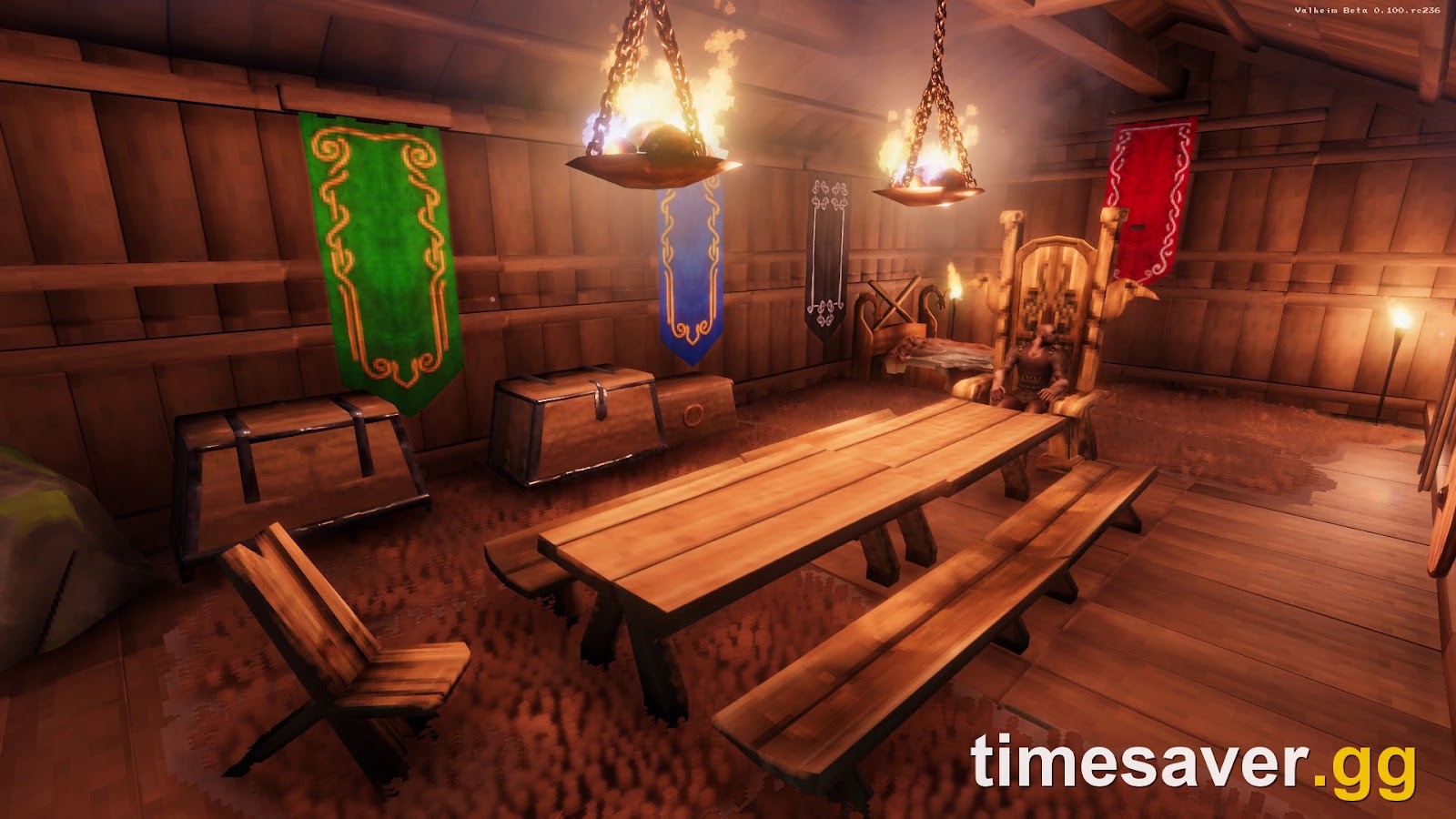
Only the highest item in each category counts. Two rugs don't stack. The 22-comfort room:
| Category | Best item | Comfort |
|---|---|---|
| Base | Sheltered near a fire | 2 |
| Chair | Any throne (Raven, Stone, Black marble, Bone, Antler) | 3 |
| Bed | Dragon bed | 2 |
| Table | Round table, Long heavy table or Long Carved Table | 2 |
| Fire | Hearth | 2 |
| Bathroom | Hot tub (heated) | 2 |
| Light | Lava lantern or Snow Lantern | 2 |
| Rug | Bearskin, Wolf, Lox rug or Moose Hide Carpet | 2 |
| Banner | Red or Blue Jute Curtain, Blue Jute Drapes | 2 |
| Plant | Flower Garland or Fey Lights | 1 |
| Ashlands | Any green pot or Asksvin skeleton | 1 |
| Stand | Armor stand or item stand | 1 |
Max comfort by progression: 5 with Meadows gear, 13 in the Black Forest, 15 in the Swamp, 17 in the Mountains, 19 in the Plains, 20 in the Mistlands and 22 from the Ashlands on. The Deep North doesn't raise the cap. Strong food is the other half of survivability, so pair a 22-comfort room with our Valheim food tier list.
How do you defend a Valheim base from raids?
How the game decides on a raid (per the wiki's Events and Player base pages):
- Every 46 minutes there's a 20% chance of an event.
- Most raids only target a player who is within 40 m of at least 3 player-base structures, isn't in a dungeon, and is in a biome that event allows. The exception is the wolf event, "You are being hunted...", which doesn't need a base.
- Which raids can fire depends on which bosses are dead. 1.0 added Jotun events ("The Jotun have found you").
- Player-base structures stop creatures spawning around them (raid spawns included, physical spawners excluded). The radius varies: 10 m for lanterns such as the Lava and Hooded Lantern, 20 m for beds, portals, wards, smelters and most stations, 25 m for a Campfire, 30 m for a Hearth or Bonfire, and 40 m for the Artisan Table. The Workbench, Forge, Black Forge and Galdr Table grow with upgrades. 1.0.14 increased the player-base effect on some build pieces "to block enemies more."
Fixes experienced builders use:
- Keep a buffer. Many builders leave about 8–10 m between the outer wall or moat and the buildings so trolls can't smash structures from the perimeter.
- Dig a moat. Most ground enemies can't cross a deep trench, and it only costs pickaxe time.
- Add stake walls and raised earth for jumpers, plus a platform to shoot from.
- Think about where you settle. A Meadows/Black Forest border is convenient early. Settling in the Plains before you're geared invites raids you can't handle yet.
A step-by-step base-building workflow
New builders tend to start with walls, then tear everything down when the roof won't line up. A cleaner order:
- Lay the footprint with floors (and 1×2 walls as a ruler) before building anything vertical. In the Deep North, shovel the snow first.
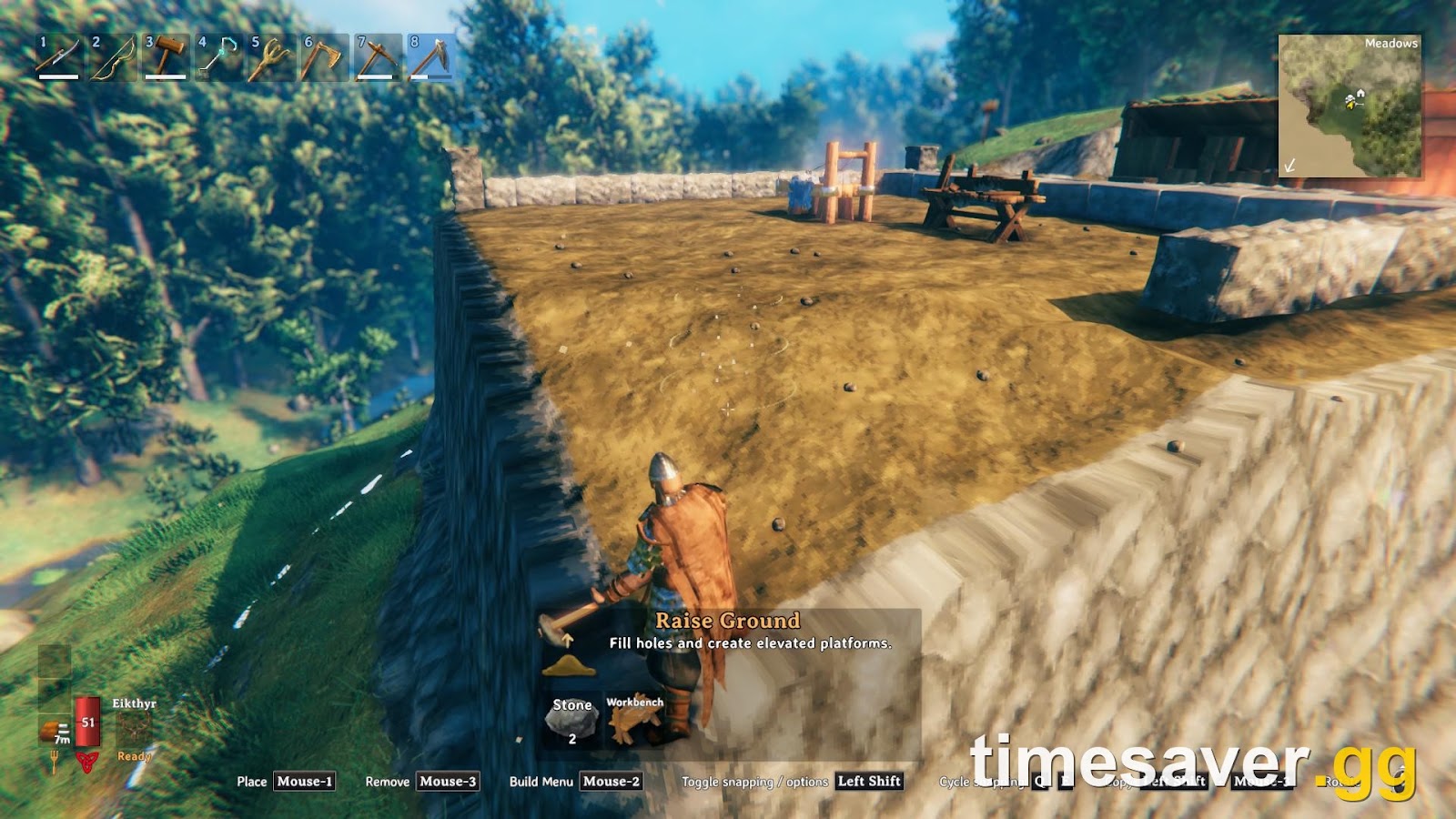
- Raise the terrain under the footprint with the Hoe until the floor shows blue. Do this before you build upward.
- Frame the roof supports. Settle your pillar and beam grid and any stairs now, since they dictate everything above. Use core wood for frames up to 24 m and wood-iron above that.
- Roof early, so the interior is sheltered from day one. 1.0's 67° pieces make steep longhouse roofs easy.
- Handle heat and smoke. Place your Hearth and leave a smoke hole or chimney, protected from rain, or you'll take smoke damage indoors.
- Furnish for comfort, one item per category, then lay out storage and resource stacks.
- Finish the outside. Most of the replies on an October 2026 r/ValheimBuilds "Building Advice" thread were about the surroundings, not the house: "All you are missing is lighting and exterior work." Paths, fencing, lanterns and a garden make a solid build look finished.
Choosing where to build? Our Valheim best seeds guide lists worlds with strong starting spots, and the portals guide covers wiring outposts back to your main hall.
Frequently Asked Questions
Why does my Valheim base keep falling down? A piece ran out of support. Support is inherited and drops with distance from grounded terrain, especially sideways. A plain wood or stone column can only rise 16 m. Run wood-iron poles straight down to the ground, raise the terrain under the build until it shows blue, and support high points from directly below.
What is the strongest building material in Valheim? Among the main building materials, Grausten from the Ashlands has the highest max support (2,000), followed by iron and black marble (1,500), then stone (1,000). For height and overhangs, iron is best because it loses the least support in every direction. Wood-iron poles reach 50 m.
Why is my beam blue in Valheim? Blue means the piece is at its material's full support. Terrain, rocks, trees (including small shrub-type trees) and the Hoe's placeable boulders all count as ground, so a beam whose hitbox touches a trunk shows blue even high in the air. A wood beam resting on well-supported stone or iron can also show blue.
What is the max comfort level in Valheim 1.0? 22, giving 29 minutes of Rested. You need one item from each category: a throne, dragon bed, darkwood or carved long table, heated hot tub, hearth, lava or snow lantern, a tier-2 rug, a jute curtain, a garland, a green pot and a stand, all inside a sheltered room. The seasonal Maypole and Yule tree can push it to 24.
How do you build in the Deep North in Valheim? Clear the snow first with the Snow Shovel, a 1.0 tool crafted at a level-3 Black Forge (5 Finewood, 4 Flametal, 2 Embers). It only works in the Deep North. Then chop fir and pine logs there for Timberwood, which unlocks the Timber and Scalewood pieces. Back up your world before long sessions. Patches 1.0.16 and 1.0.17 fixed terrain-revert and object-loss bugs, but a backup is cheap.
Do raids happen if I'm away from my base? Most raids target a player who is within 40 m of at least 3 player-base structures, so if nobody is near the base, those won't start there. The wolf event "You are being hunted..." is the exception and can find you anywhere it's allowed. Most events also pause their timer when no player is in the event area.
More Valheim guides
For your first hours before you commit to a permanent base, start with our Valheim beginner's guide. For more, browse all our Valheim guides.